Race-Day Roles and Who Should Own Each One
On race day, every critical task needs exactly one person who owns it. When two people share responsibility, both assume the other is handling it — and things fall through the cracks. Here is a complete role breakdown for a community 5K so you can assign every task to one clear owner.
Quick Answer
A community 5K needs 8 to 12 clearly defined race-day roles, each owned by one person: race director, volunteer coordinator, registration lead, course marshal captain, start line manager, finish line manager, timing and results lead, water station lead, awards and announcements, photography and social media, parking and traffic control, and medical or first aid lead.
The Principle of Single Ownership
The golden rule of race-day operations: every task has one owner. Not two, not a committee — one person who is responsible, accountable, and empowered to make decisions. If something goes wrong with registration, everyone knows to find the registration lead. If a course marshal does not show up, the course marshal captain handles it without involving the race director.
This principle prevents the most common race-day failure: assuming someone else is handling it.
Core Race-Day Roles
Race Director
Owns: The overall event. Final decisions. Problem escalation.
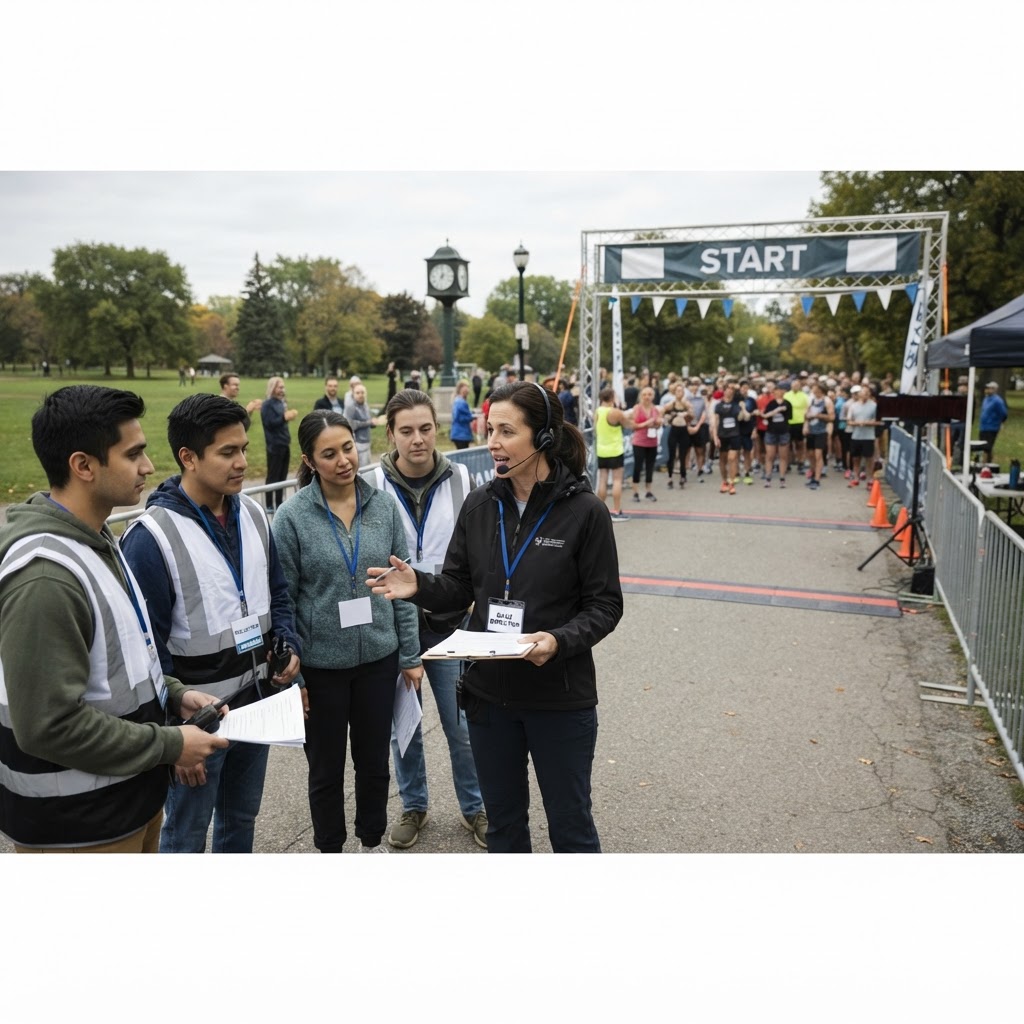
The race director does not run a specific station. Instead, they float, observe, and solve problems that arise. They are the one person who can make a call on weather delays, course changes, or schedule adjustments.
Responsibilities:
- Arrive first, leave last
- Conduct the volunteer briefing
- Monitor the timeline and keep things on schedule
- Handle escalations that volunteer leads cannot resolve
- Make the call on weather, safety, or course issues
Who to assign: The person who has been planning the event from the beginning. This is not a role for a first-time volunteer.
Volunteer Coordinator
Owns: All volunteers — check-in, assignments, gap-filling, and problem-solving.
The volunteer coordinator is the human resources manager of race day. They check in every volunteer, confirm their assignment, handle no-shows, and redeploy volunteers where needed.
Responsibilities:
- Set up and staff the volunteer check-in station
- Distribute role assignments and shift times
- Track who has arrived and who is missing
- Fill gaps by reassigning floaters
- Be the point of contact for volunteer questions
Registration Lead
Owns: Packet pickup, walk-up registration, and the cash box.
Responsibilities:
- Set up the registration area 60 to 90 minutes before start
- Organize bibs and shirts by number for fast lookup
- Process walk-up registrations and collect payment
- Manage the cash box and reconcile at the end
- Close registration 15 minutes before the start
Course Marshal Captain
Owns: All course marshals — placement, communication, and coverage.
Responsibilities:
- Deploy marshals to assigned intersections and turns
- Confirm every intersection is covered before the race starts
- Communicate via radio or phone with the race director
- Check on marshals during the race to ensure they are OK
- Recall marshals after the last runner passes their station
Start Line Manager
Owns: The start — runner staging, countdown, and clean release.
Responsibilities:
- Organize runners at the start line
- Give the pre-race safety briefing (course description, water station location, finish line instructions)
- Count down and start the race on time
- Ensure the start area is clear for the first runners to return
Finish Line Manager
Owns: The finish — timing, chute management, and post-finish flow.
Responsibilities:
- Set up the finish line chute and banner
- Work with the timing lead to ensure smooth finish line recording
- Keep runners moving through the finish area
- Hand out water and medals at the finish
- Prevent bottlenecks and keep the finish area clear for media and spectators
Timing and Results Lead
Owns: Accurate timing and results publication.
Responsibilities:
- Set up and test the timing system before the race
- Distribute and collect timing chips if using chip timing
- Record finish times and bib numbers for manual timing
- Produce preliminary results immediately after the last runner finishes
- Post official results and handle any disputes
Water Station Lead
Owns: Water station setup, operation, and cleanup.
Responsibilities:
- Set up the water station table with cups pre-filled
- Hand out water efficiently to runners
- Keep the table stocked throughout the race
- Clean up cups and trash after the last runner passes
- Break down the station and transport supplies
Awards and Announcements
Owns: The awards ceremony and public address system.
Responsibilities:
- Set up the PA system or megaphone
- Announce race results and award winners
- Present age-group and overall awards
- Thank sponsors and volunteers publicly
- Keep the ceremony on schedule
Photography and Social Media
Owns: Capturing the event visually and sharing in real time.
Responsibilities:
- Photograph the start, finish, and key moments
- Capture sponsor visibility (logos on shirts, banners, signage)
- Take candid shots of volunteers and participants
- Post real-time updates to social media if the event has a following
- Share photos with the race director for post-race marketing
Parking and Traffic Control
Owns: Arriving traffic flow and parking logistics.
Responsibilities:
- Direct arriving cars to designated parking areas
- Prevent parking on the course or in restricted zones
- Keep the entrance and exit clear for emergency vehicles
- Manage pedestrian crossings near the parking area
Medical or First Aid Lead
Owns: Participant safety and medical response.
Responsibilities:
- Set up a first aid station near the finish line
- Stock basic medical supplies (bandages, ice, electrolytes)
- Monitor runners at the finish for distress
- Contact emergency services if needed
- Have a plan for heat, cold, or weather-related issues
How to Assign Roles
Match Skills to Tasks
Assign roles based on experience and comfort level. A detail-oriented person is better at registration; a natural leader works well as the course marshal captain; a calm problem-solver makes a good race director.
Give Each Owner a Written Brief
Every role owner should receive a one-page brief before race day that includes:
- Their specific responsibilities
- Their arrival time
- Their assigned volunteers (if applicable)
- The race director's phone number
- The timeline for their area
Designate Backups
For critical roles (race director, timing, registration), have a designated backup who can step in if the primary owner is unavailable. Communicate the backup chain in advance.
Practice the Chain of Command
Problems should flow upward: volunteer → volunteer lead → race director. Every volunteer should know who to report to, and every lead should know when to escalate to the race director. This prevents the race director from being pulled into minor issues.
The Race-Day Command Sheet
Create a single document that lists every role, the person assigned, their phone number, arrival time, and key responsibilities. Print copies for every lead. This is your race-day Bible — if something goes wrong, the command sheet tells you who to call.
Bottom Line
Every race-day task needs one clear owner with the authority and information to handle it. Assign 8 to 12 core roles, give each owner a written brief, and practice the chain of command. The Race Director Toolkit race-day command center helps you assign roles, track contacts, and build your command sheet in one place.
Next step: Get the free 5K planning checklist to map your race-day roles before the big day.
Free checklist for first-time race directors
If you are organizing your first 5K or fun run, start with the free 5K Planning Checklist. Spot the gaps that create stress later: budget surprises, missing volunteers, sponsor deadlines, shirt timing, and race-day communication.
Build the full race plan
Race Director Toolkit turns the checklist into a working plan — budget calculator, sponsor tracker, volunteer planner, vendor coordination, marketing calendar, and race-day command center.
- Race Planner — $147 one-time
- Planner + AI Assistant — $247 one-time
- 10 guided planning modules
- Budget & break-even planner
- Sponsor tracker, volunteer planner, vendor tracker