What to Ask a Timing Company Before Signing a Contract
A timing company is one of your largest single expenses and one of the most important vendor relationships for your race. The right company delivers accurate results, professional service, and peace of mind. The wrong one creates errors, delays, and frustrated participants. Here are the questions to ask before you sign.
Quick Answer
Ask every timing company about their timing technology (chip vs. manual), what is included in the price, how many staff they provide, how results are published and shared, their contingency plan for equipment failure, their cancellation policy, and references from other race directors they have worked with. Get everything in writing before signing.
Questions About Technology and Accuracy
What Timing Technology Do You Use?
There are two main approaches:
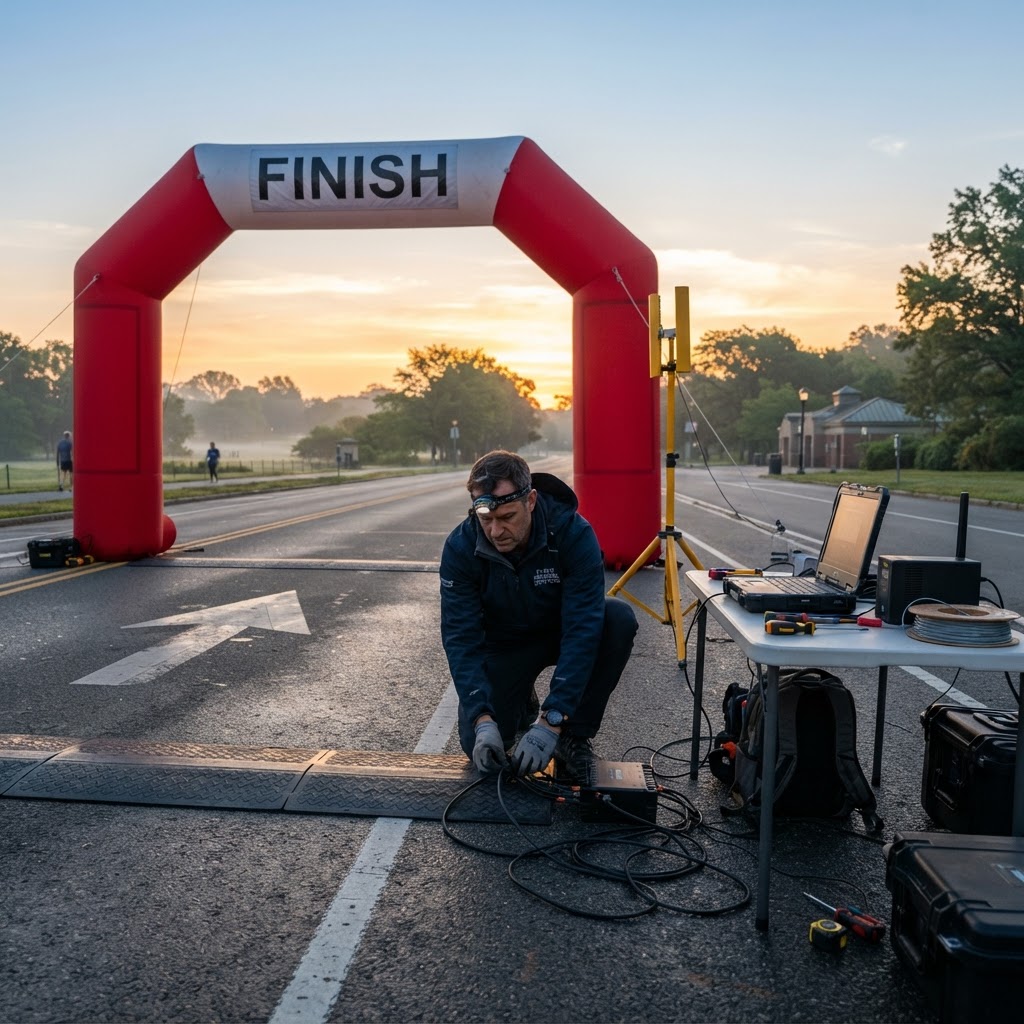
- Chip timing — Each runner wears a timing chip (on their bib or shoe) that is read by mats at the start and finish. This provides accurate individual times, including net time (actual time from when the runner crosses the start line to when they cross the finish).
- Manual timing — A person operates a stopwatch and records bib numbers as runners cross the finish line. Less accurate but much cheaper.
Follow-up questions:
- Is the chip disposable or reusable? (Disposable chips are simpler; reusable chips require collection at the finish line)
- Do you provide gun time, net time, or both? (Gun time is from the start signal; net time is from when the runner actually crosses the start line)
- What is your accuracy margin? (Professional chip timing should be accurate to within 0.1 seconds)
How Do You Handle a Large Finish Line Surge?
If 50 runners cross the finish line within 30 seconds, how does your system handle it without missing anyone?
- Chip timing systems read multiple chips simultaneously, so this is generally not an issue
- Manual timing requires multiple recorders and a finish chute that slows runners enough to record bib numbers
What Happens If a Chip Fails?
- Do you have a backup manual timing system running simultaneously?
- How quickly can you identify and correct a missed or incorrect read?
- Do you provide a backup timing mat or secondary system?
Questions About What Is Included
What Exactly Is Included in Your Price?
Get an itemized list. Some companies quote a base price and charge extra for everything else. Ask specifically:
- Timing mats and hardware — Setup, operation, and breakdown
- Timing staff — How many people, and how many hours?
- Bibs and chips — Are these included or extra? What is the per-runner cost?
- Results kiosk — Do you provide a screen or printout at the finish line for runners to see results?
- Online results — Where are results posted? How quickly after the race?
- Age-group awards calculation — Do you calculate and sort results by age group?
- Custom race categories — Can you handle teams, age groups, or special categories?
What Is Not Included?
- Shirts, medals, or awards — Usually not included
- Course measurement — You handle this
- Start and finish line infrastructure — Arches, banners, and chutes may be extra
- PA system — Usually not included
- Photography — Not included unless specifically contracted
What Are the Per-Runner Costs?
Some companies charge a flat fee; others charge a base rate plus a per-runner fee. Understand the structure:
- Flat fee: $400-$600 for up to 300 runners, additional runners $1-$2 each
- Per-runner: $2-$4 per registrant, no flat fee
- Hybrid: $300 base plus $1.50 per runner
Get a written quote with your estimated participant count.
Questions About Staffing and Setup
How Many Staff Do You Bring?
For a 5K with up to 300 runners, expect:
- 1 to 2 staff for manual timing
- 2 to 3 staff for chip timing (one to manage the system, one to hand out and collect chips, one to manage results)
What Time Do You Arrive?
The timing company should arrive 60 to 90 minutes before the race start to set up and test equipment. Confirm their arrival time and build it into your setup timeline.
What Do You Need From Us?
- Power source (generator or outlet) for timing equipment
- Table at the finish line for the timing station
- Volunteer support for chip distribution or bib collection
- Clear start and finish line markers
Do You Provide a Results Display at the Finish?
A results kiosk or screen where runners can see their time immediately after finishing is a major participant satisfaction feature. Ask if it is included, and if so, what format (TV screen, tablet, printed sheets).
Questions About Results Publication
How Quickly Are Results Available?
- Preliminary results: Should be available within 15 to 30 minutes of the last runner finishing
- Official results: Should be posted within 2 to 24 hours online
Where Are Results Posted?
- Company website — Most post results on their own site
- Your race website — Can they push results to your site or embed a widget?
- Social media — Do they share results on Facebook or other platforms?
- Email — Can they email results to registered runners?
Can You Handle Age-Group Awards?
If you give awards for age groups (for example, top 3 in each 5-year age bracket), confirm the timing company can:
- Calculate and sort results by age group
- Identify award winners immediately after the race for your ceremony
- Handle ties or close finishes
What Format Do You Provide Results In?
- CSV or Excel — For your records and marketing
- PDF — For posting on your website
- Online searchable — Where runners can search by name or bib number
Questions About Contingencies and Reliability
What Is Your Plan If Equipment Fails?
- Do you run a backup manual timing system simultaneously?
- Do you have spare mats or chips on-site?
- What is your process for resolving disputed times?
What Is Your Weather Policy?
- Do you operate in rain? What about lightning?
- Is there a surcharge for rescheduling due to weather?
- What happens to the deposit if the race is cancelled?
What Is Your Cancellation Policy?
- If you cancel the race, do you owe the full fee or a partial fee?
- How much notice is required to cancel without penalty?
- If the timing company cancels, what is their obligation to you?
Can You Provide References?
Ask for contact information for 2 to 3 race directors they have worked with. Call them and ask:
- Were results accurate and on time?
- Was the staff professional and easy to work with?
- Did they deliver everything promised in the contract?
- Would you hire them again?
Questions About the Contract
What Are the Payment Terms?
- Deposit: Typically 25% to 50% to hold the date
- Balance: Due before or on race day
- Cancellation: What is refundable and under what conditions?
What Is the Scope of Work?
The contract should specify:
- Date, time, and location of the event
- Expected participant count (and what happens if you exceed or fall short)
- Exact services included
- Equipment provided
- Staff count
- Results delivery timeline and format
- Price and payment schedule
What Happens If Participant Count Changes?
If you estimate 200 runners and get 250, or only get 150, how does pricing adjust? Most companies have a threshold — for example, the flat fee covers up to 300 runners, with a per-runner charge above that.
Red Flags to Watch For
- No backup timing system — If they cannot tell you their contingency plan, walk away
- Vague pricing — If they will not put per-runner costs in writing, find another company
- No references — If they cannot provide other race directors as references, they may be new or unreliable
- No-show at pre-race meeting — If they are hard to reach before you sign, they will be harder to reach on race day
- No contract — Everything should be in writing, including scope, price, and cancellation terms
Bottom Line
A good timing company is worth every penny. They deliver accurate results, professional service, and peace of mind. Ask the right questions, get everything in writing, and check references. The Race Director Toolkit vendor tracker helps you compare timing company quotes, track contract terms, and manage deposits and payment schedules.
Next step: Get the free 5K planning checklist to build your vendor comparison list and timing questions before you start calling companies.
Free checklist for first-time race directors
If you are organizing your first 5K or fun run, start with the free 5K Planning Checklist. Spot the gaps that create stress later: budget surprises, missing volunteers, sponsor deadlines, shirt timing, and race-day communication.
Build the full race plan
Race Director Toolkit turns the checklist into a working plan — budget calculator, sponsor tracker, volunteer planner, vendor coordination, marketing calendar, and race-day command center.
- Race Planner — $147 one-time
- Planner + AI Assistant — $247 one-time
- 10 guided planning modules
- Budget & break-even planner
- Sponsor tracker, volunteer planner, vendor tracker