How Many Volunteers Does a 5K Need?
A community 5K with 150 to 300 participants typically needs 15 to 25 volunteers to run smoothly. The exact number depends on your course layout, whether you have chip timing, and how many water stations you operate. Below is a practical breakdown so you can staff your event with confidence.
Quick Answer
Plan for roughly one volunteer for every 10 to 15 registered runners, with a minimum crew of 12 for even the smallest fun run. A 200-runner 5K on a neighborhood course with one water station and manual timing needs about 18 to 20 volunteers. Add 3 to 5 more if you have chip timing, a complex course, or multiple water stations.
Why Volunteer Count Matters More Than You Think
First-time organizers often underestimate volunteer needs because they focus on race-day excitement and forget the operational backbone. Too few volunteers means safety risks at intersections, bottlenecks at registration, and a stressful experience for everyone involved. Too many volunteers without clear assignments creates confusion and wasted time.
The goal is right-sized staffing: enough people to cover every critical role with a small float buffer, and not so many that people stand around with nothing to do.
Core Volunteer Roles for a Community 5K
Race Morning Setup (4-6 volunteers)
These volunteers arrive 60 to 90 minutes before the start:
- Registration and packet pickup (2-3 people) — Hand out bibs and shirts, check in walk-up registrants, manage the cash box
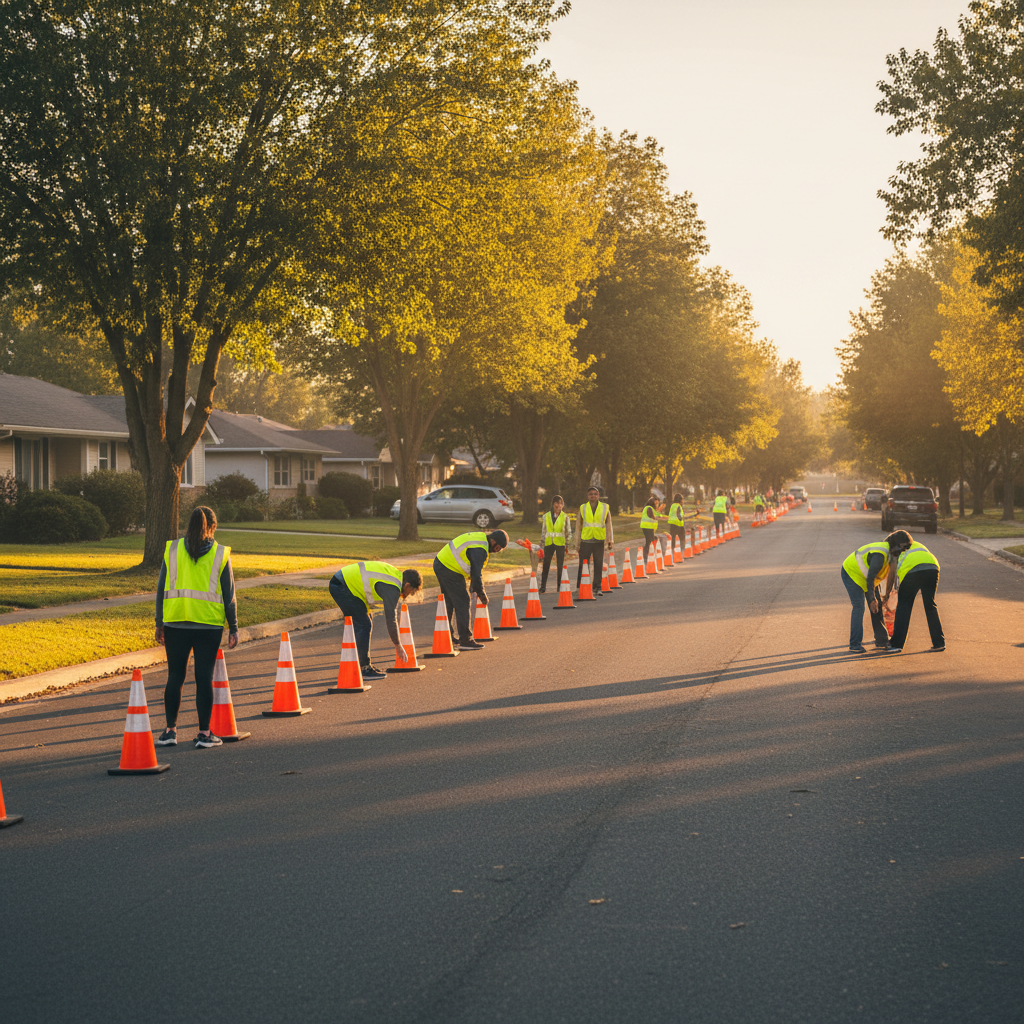
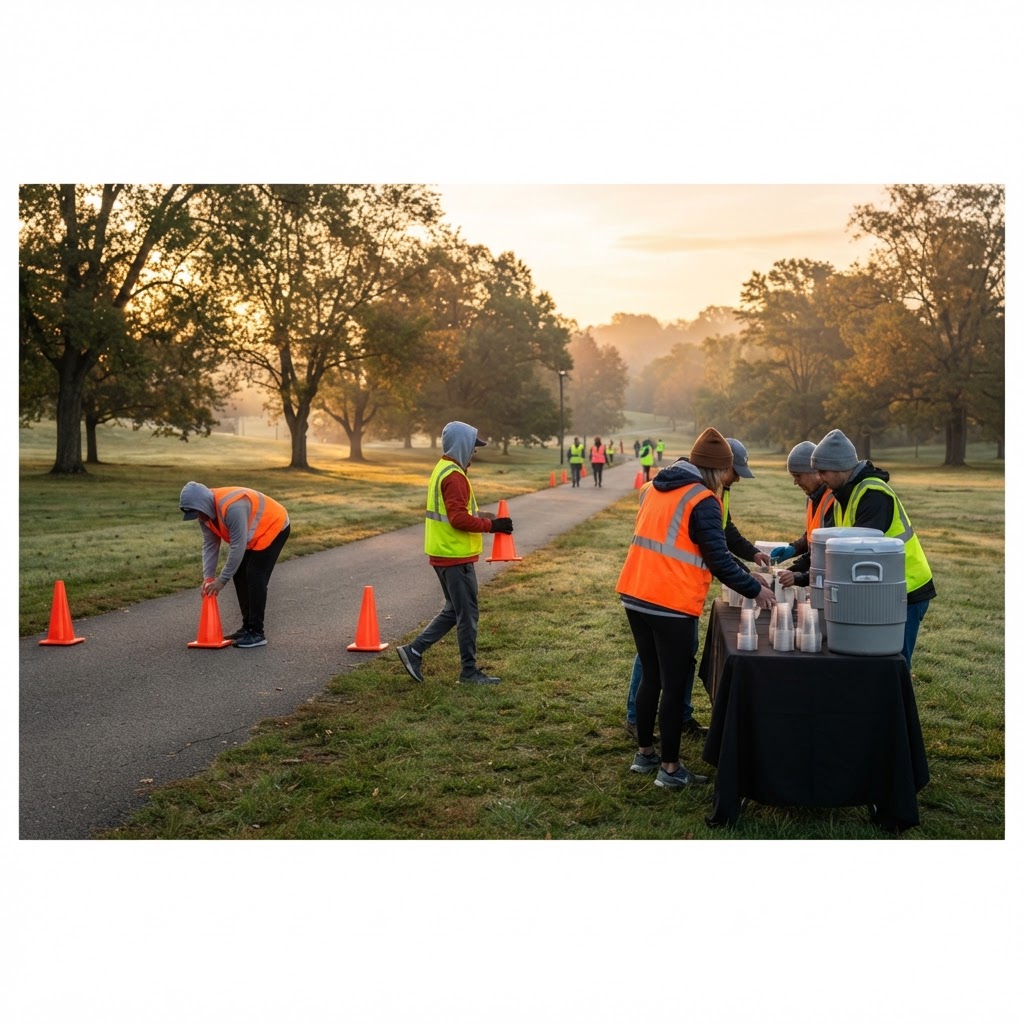
- Course setup (2-3 people) — Place traffic cones, directional signs, and start/finish line banners
Start and Finish Line (3-5 volunteers)
- Start line marshal (1 person) — Organize runners, give pre-race briefing, count down
- Finish line timer and recorder (1-2 people) — Operate the stopwatch or timing system, record bib numbers and times
- Finish chute management (1-2 people) — Keep runners moving through the finish area, hand out medals or water
Course Marshals (4-8 volunteers)
This is where most events are understaffed. You need one volunteer at every intersection or turn where runners could go off course:
- Intersection control — Stand at road crossings to stop traffic and direct runners
- Turn directors — Positioned at every turn where the course changes direction
- Out-and-back turnaround — One person at the halfway point to prevent cutting
Rule of thumb: Count the number of intersections and turns on your course. That is your minimum course marshal count.
Water Station (2-4 volunteers)
If you have one water station at the halfway point:
- Cup fillers (1-2 people) — Pre-fill cups and hand them out efficiently
- Table manager (1 person) — Keep the table stocked and organized
- Cleanup crew (1 person) — Pick up cups and break down the station after the last runner passes
Floaters and Support (2-3 volunteers)
Every race needs floaters who can fill gaps:
- Photographer or social media (1 person) — Capture finish line moments and crowd shots
- Parking and crowd control (1 person) — Direct arriving traffic and keep spectators off the course
- General floater (1 person) — Rotate wherever help is needed most
How to Adjust for Your Specific Event
Participant Count Impact
| Runners | Minimum Volunteers | Recommended | |---------|-------------------|-------------| | 50-100 | 12 | 12-15 | | 100-200 | 15 | 15-20 | | 200-300 | 20 | 20-25 | | 300-500 | 25 | 25-35 |
Course Type Adjustments
- School property or park loop — Fewer marshals needed (2-4) because the course is contained
- Neighborhood streets — More marshals needed (6-8) for intersection control and traffic management
- Trail or mixed terrain — Add 2-3 trail guides who are familiar with the route
Features That Add Volunteers
- Chip timing — Add 1-2 people for timing chip distribution and finish line scanning
- Food and refreshments — Add 2-3 people for food prep, serving, and cleanup
- Kids fun run — Add 3-4 people for a separate short course with its own start and finish
- Awards ceremony — Add 1 person to manage awards and announcements
The One Role Most Organizers Forget
Parking director. This is the most overlooked volunteer role. One person dedicated to directing arriving cars to parking spots prevents gridlock at the entrance and keeps the start time on schedule. Without this role, late arrivals park illegally, block the course, and create chaos before the race even begins.
Your Volunteer Recruitment Timeline
6-8 Weeks Out
- Finalize your volunteer role list based on expected registration numbers
- Create a simple sign-up sheet or use a free tool like Google Forms
- Send recruitment emails to local running clubs, service organizations, and school groups
3-4 Weeks Out
- Confirm volunteer commitments with personal emails or calls
- Assign specific roles and shift times
- Send a volunteer guide with arrival time, parking, and what to wear
1 Week Out
- Send a reminder email with final assignments
- Identify backup volunteers who can fill in for cancellations
- Prepare a volunteer check-in station for race morning
Race Morning
- Set up a volunteer briefing 30 minutes before the start
- Assign a volunteer coordinator who manages the crew and solves problems
- Have a printed role assignment sheet at the check-in table
What to Do If You Are Short on Volunteers
If you are 3-4 volunteers short on race morning:
- Prioritize safety roles first — Course marshals at intersections and the start/finish line are non-negotiable
- Combine roles — Have one person manage both packet pickup and walk-up registration
- Ask for help from participants — Ask early arrivals if they have a family member who can help for an hour
- Use your floater wisely — Deploy your one unassigned person wherever the need is greatest
Bottom Line
Plan for 15 to 25 volunteers for a typical community 5K of 150 to 300 runners. Map your course, count your intersections, and assign every volunteer a specific role with a clear arrival time. The Race Director Toolkit volunteer planner helps you track volunteer roles, shift times, and staffing gaps so you never show up short on race morning.
Next step: Get the free 5K planning checklist to see every role you need to fill.
Free checklist for first-time race directors
If you are organizing your first 5K or fun run, start with the free 5K Planning Checklist. Spot the gaps that create stress later: budget surprises, missing volunteers, sponsor deadlines, shirt timing, and race-day communication.
Build the full race plan
Race Director Toolkit turns the checklist into a working plan — budget calculator, sponsor tracker, volunteer planner, vendor coordination, marketing calendar, and race-day command center.
- Race Planner — $147 one-time
- Planner + AI Assistant — $247 one-time
- 10 guided planning modules
- Budget & break-even planner
- Sponsor tracker, volunteer planner, vendor tracker